The Energy Impact of AI: Why Do Data Centers Consume So Much Power?
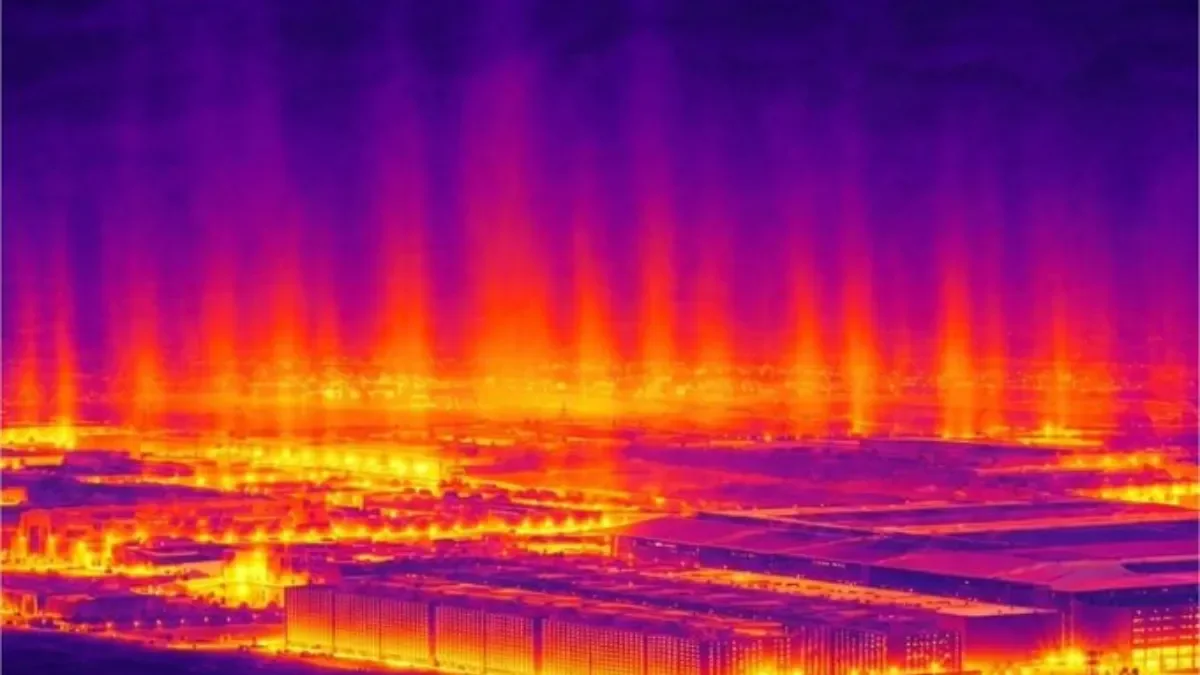
Recently, a phrase went viral on social media claiming that future Artificial Intelligence data centers would dump the equivalent of '23 atomic bombs of energy every day in Utah'. While the language is sensationalist, intended to shock, it highlights the Achilles' heel of the AI revolution: the unsustainable scale of energy consumption and thermal dissipation.
In this article, we'll break down what this metric really means, how energy turns into heat in GPU clusters, and why Utah has become the center of this debate.
The Math of the 'Shock': Joules vs. Gigawatts
To understand the '23 atomic bombs' claim, we need to convert the metaphor into data center physics. The Hiroshima bomb released approximately 63 Terajoules (TJ) of energy. Multiplying that by 23 gives us about 1,449 TJ per day.
Converting this energy to continuous power results in about 16.7 Gigawatts (GW) of constant consumption. For perspective, a standard nuclear reactor generates about 1 GW. Thus, the claim suggests that the planned AI infrastructure for a region would require the equivalent of 16 nuclear plants running 24/7.
In practice, real 'Giga Data Center' AI projects (like those discussed by OpenAI and Microsoft) aim for 1 to 5 GW per campus. Therefore, the number '23' is a projected future scenario for multiple combined campuses, serving as a clear warning: training and running AI models demand nation-scale infrastructure.
The Thermodynamic Cycle: Electricity to Heat
In a traditional data center, electricity serves two primary purposes: powering servers and powering the cooling system. In an AI data center, the game changes due to the density of next-gen GPUs (like Nvidia's Blackwell architectures).
- Training: Models like GPT-4 require tens of thousands of GPUs running at full capacity for months on end, consuming megawatts per hour.
- Inference: Every time you send a prompt to ChatGPT or Claude, servers are using electricity to compute the response in real-time. As AI is used by hundreds of millions daily, inference has already surpassed training in global energy consumption.
The fundamental problem is the First Law of Thermodynamics: energy doesn’t disappear. The electricity entering server racks is almost 100% converted into heat. If a data center consumes 1 GW of electricity, it effectively becomes a 1 GW heater. This is why the atomic bomb metaphor focuses on 'dumping energy' (heat) into the local environment.
Why Utah? The Water and Desert Battle
The state of Utah, USA, has been a frequent target for data center expansion due to relatively low land costs and tax incentives. However, Utah is predominantly a desert state facing historic droughts.
To dissipate the immense heat generated by AI clusters, the most efficient and cost-effective method is often evaporative cooling (cooling towers consuming millions of liters of potable water). The clash between the insatiable water demand of data centers and the local water crisis has sparked outrage and sensationalist headlines on social media.
The Future: How Does the Industry Plan to Survive?
The tech industry knows the current scale is unsustainable. To avoid power grid collapses and local community backlash, three fronts are being developed:
- More Efficient Chips: New architectures delivering more teraflops per watt, reducing heat generation per operation.
- Direct Liquid Cooling (DLC): Replacing brute-force air conditioning and water evaporation with closed-circuit refrigerant fluids directly touching the chips.
- Proprietary Nuclear Power: Companies like Amazon, Google, and Microsoft are buying up decommissioned nuclear plants or investing in Small Modular Reactors (SMRs) dedicated exclusively to powering AI, isolating it from the public power grid.
While the atomic bomb metaphor is a dramatic hyperbole, the technical truth isn't far off. Artificial Intelligence is fundamentally a technology that transforms electricity into intellect — and the world is just beginning to discover the power bill for this advancement.
This content was created and reviewed by our team (iatoskill.com), if you find any issues, please reach out to us