Google AI Agents Build Bootable OS Kernel in 12 Hours
On Tuesday, May 19, 2026 (UTC), Google announced a milestone in software engineering by demonstrating that its new agent platform, Antigravity 2.0, was able to design and compile a fully functional bootable operating system kernel in just 12 hours. This technological feat, shared by engineers from the research division in Mountain View, involved an automated orchestration without direct human intervention to structure the software's vital subsystems.
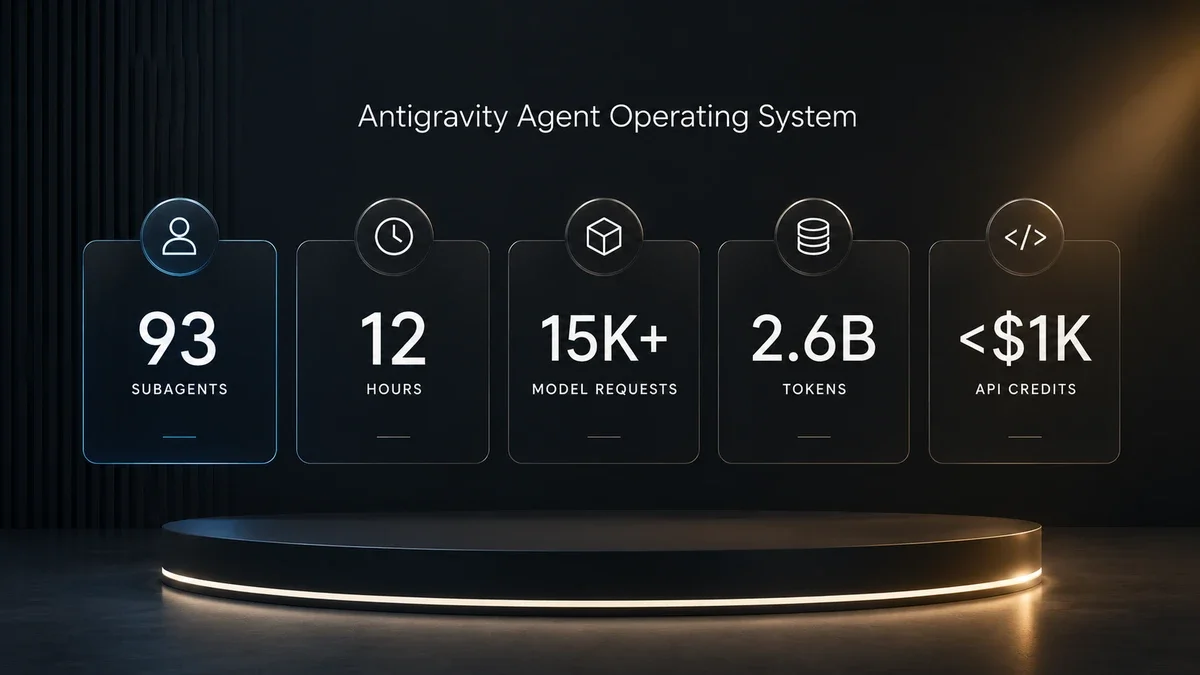
According to official data released by the development team in posts shared on the social network X (formerly Twitter), the system was based on the Gemini 3.5 Flash language model. The platform managed a team of 93 intelligent sub-agents working in parallel, taking on specific roles such as process architecture, physical and virtual memory management, and creating the bootloader and executable file interpreter.
Technical Performance and Processing Cost
The autonomous development process consumed a total of 15,000 individual requests to the language model, resulting in the processing of 2.6 billion tokens. Despite the massive volume of contextual data exchanged between the sub-agents during bug validation and correction, the total financial cost of the computation was under $1,000, highlighting the high cost-efficiency of the new inference architecture.
To prove the stability of the kernel generated by the artificial intelligence agents, the team conducted a live demonstration. The minimalist operating system successfully booted on an emulator and smoothly ran an adapted version of the classic game Doom, a traditional test in the hardware community to attest to the operational capability of new kernels and processors.
Availability and Developer Tools
The Antigravity 2.0 ecosystem was immediately made available as a free application, accompanied by a command-line interface (CLI) and a software development kit (SDK) compatible with macOS, Windows, and Linux systems. The environment allows human programmers to delegate high-level objectives while agents handle complex tasks such as code writing, integrity testing, and integrated web searches for documentation.
While key voices in the tech community praised the record-breaking speed of the delivery, analysts and software security skeptics raised important concerns. Experts pointed out the need for the full source code of the generated kernel to be published for external security audits and expressed doubts about the reliability of systems built entirely by predictive models in real large-scale production environments.
This content was created and reviewed by our team (iatoskill.com), if you find any issues, please reach out to us